
TANKE Influencer Marketing Maturity Model
The TANKE Influencer Marketing Maturity Model is a framework that classifies how brands operate influencer marketing across five levels, from Random (ad hoc activations with no framework) to Integrated (influence arbitrated inside the media mix like TV or paid social), evaluated on six dimensions: business logic, organisation and team, sourcing and vetting, creativity and content, creator relationships, and measurement and governance. Developed by TANKE, the Paris-based influencer marketing agency founded in 2014, the model explains why influencer ROI varies more by operating maturity than by budget size.

What is the TANKE Influencer Marketing Maturity Model?
The model turns a vague question, “are we good at influencer marketing?”, into an operating diagnosis. It does not grade a brand by budget or follower reach. It examines whether influence has a clear business role, specialist ownership, rigorous creator selection, a productive creative system, durable creator relationships and measurement that can support investment decisions.
A brand can be advanced in one dimension and weak in another. The purpose is not to claim a badge. It is to identify the constraint that keeps influencer investment from becoming repeatable, scalable and comparable with the wider media mix.

Want to benchmark your own organisation? Answer 16 quick questions and turn the framework into a practical maturity diagnosis.
Take the 3-minute maturity auditDiscuss your maturity roadmap
Why does influencer marketing performance vary so much between brands?
TANKE’s working estimate places global influencer-marketing inefficiency at roughly 15 to 18 percent of spend, or about USD 5 to 6 billion a year. The estimate combines bad influence, including fake followers, bots and artificial engagement, with misallocation to the wrong tier, fit or audience. Weak sales measurement then amplifies both problems because teams cannot learn and reallocate.
The IREP deck cites 43.17 percent of analysed accounts as affected by fraud across 67.3 million Instagram, YouTube and TikTok accounts. It also notes that fewer than 20 percent of firms track real sales and that 60 percent of marketers cite ROI tracking as their leading challenge. These figures describe an operating problem, not a defect inherent to the channel.

What are the five maturity levels?
Level 1, Random: exposure without proof
“We found someone with quite a lot of followers.”
Transactional and reactive work, intuitive sourcing, one-shot creator relationships and likes or reach as the main proof. The limitation is exposure without robust evidence.
Level 2, Repeatable: repetition without a system
“We are doing another influencer wave for the next key moment.”
Campaigns recur, usually around calendar moments, but remain tactical. Basic engagement and geography guide sourcing, while creator reuse and measurement stay limited.
Level 3, Structured: influence enters marketing strategy
“We have an annual plan for influencer activations.”
Annual objectives, funnel mapping, a dedicated team or agency, audience insight, business KPIs and standard contracts create a real system. The remaining limit is partial siloing.
Level 4, Scalable: an always-on, data-led system
“Influence is integrated into the media plan and key moments, with continuous UGC and seeding connected to other communication channels.”
Multi-tier portfolios, social listening, cultural signals, ambassador programmes and full-funnel attribution make the system scalable. Complexity can still grow faster than routines.
Level 5, Integrated: influence becomes an allocation variable
Influence is integrated from the design of marketing strategies, managed through data, technology and global deployment frameworks.
Predictive cross-channel decisions, social commerce, proprietary scoring, co-creation, strategic creator partnerships, ROI, LTV and automated compliance make influence comparable with other media investments.
What are the six dimensions of the model?
The six dimensions prevent a brand from treating maturity as a single tool, hire or KPI. Progress requires aligned changes in business logic, team design, creator intelligence, creative operations, relationships and governance.
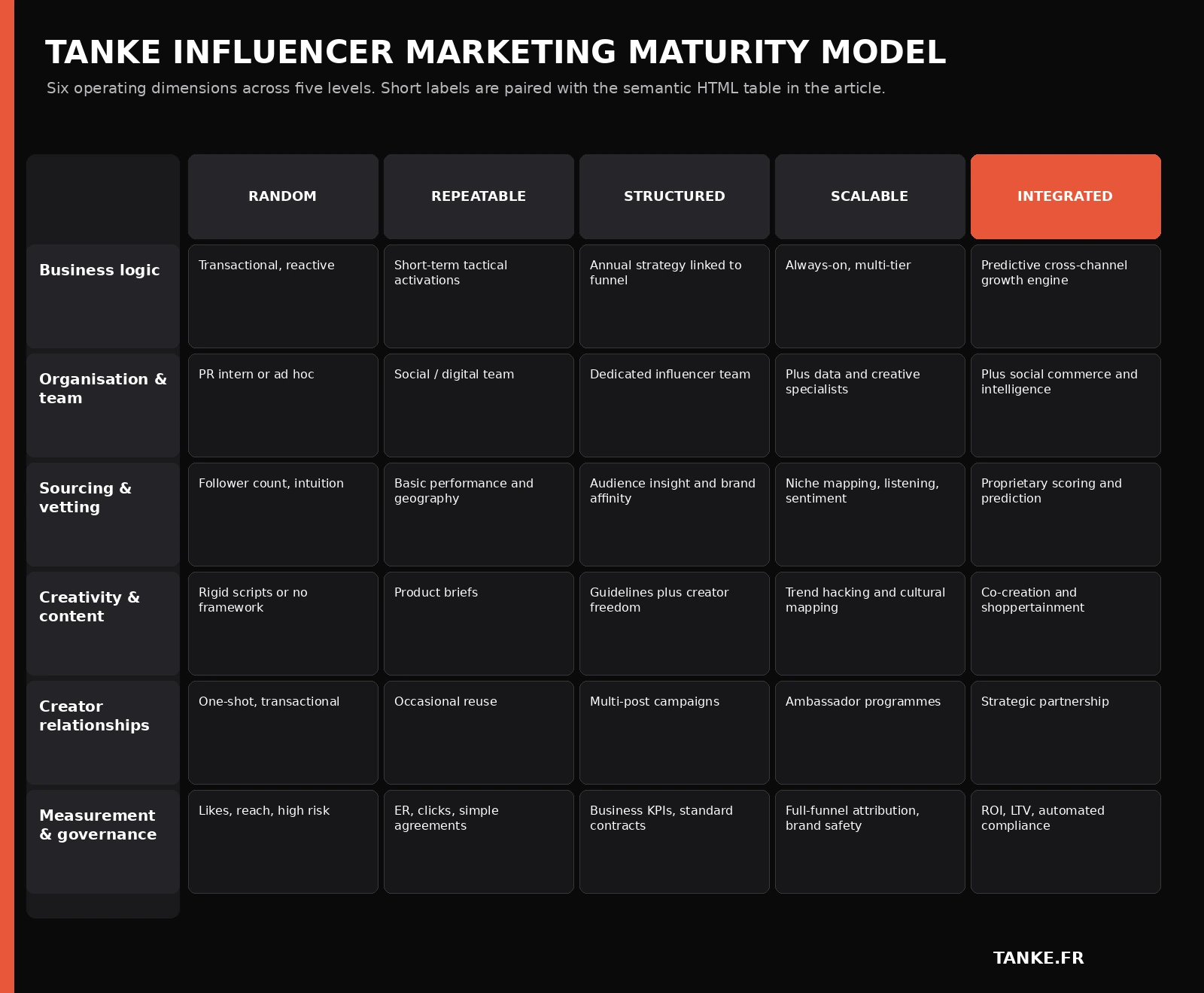
| Dimension | RANDOM | REPEATABLE | STRUCTURED | SCALABLE | INTEGRATED |
|---|---|---|---|---|---|
| Business logic | Transactional, reactive | Short-term tactical activations | Annual strategy linked to funnel | Always-on, multi-tier | Predictive cross-channel growth engine |
| Organisation & team | PR intern or ad hoc | Social / digital team | Dedicated influencer team | Plus data and creative specialists | Plus social commerce and intelligence |
| Sourcing & vetting | Follower count, intuition | Basic performance and geography | Audience insight and brand affinity | Niche mapping, listening, sentiment | Proprietary scoring and prediction |
| Creativity & content | Rigid scripts or no framework | Product briefs | Guidelines plus creator freedom | Trend hacking and cultural mapping | Co-creation and shoppertainment |
| Creator relationships | One-shot, transactional | Occasional reuse | Multi-post campaigns | Ambassador programmes | Strategic partnership |
| Measurement & governance | Likes, reach, high risk | ER, clicks, simple agreements | Business KPIs, standard contracts | Full-funnel attribution, brand safety | ROI, LTV, automated compliance |
From matrix to diagnosis. Use the interactive audit to locate your current level across the six operating dimensions.
What does the data say about mature influencer marketing?
France recorded EUR 587 million in net influencer-marketing investment in 2025, up 13.1 percent year on year and equal to 5.2 percent of digital investment, according to the ARPP and France Pub study cited in the IREP deck. Growth makes operating discipline more important because budgets can expand faster than organisations’ capacity to orchestrate them.
The IPA Databank analysis cited by TANKE covers 220 campaigns, 144 brands and 28 markets. It reports a long-term multiplier of 3.35 for influence, compared with 3.27 for linear TV and 0.77 for paid social, plus a long-term ROI index of 151. The strategic lesson is about measurement horizon: short windows can understate a channel that contributes to both demand and brand value.

“Budgets are growing faster than organisations' capacity to orchestrate them. The inefficiency we measure in influencer marketing, 15 to 18 percent of global spend, is not a property of the channel. It is a property of immaturity. Investment buys volume; only structure buys integration. So if you throw money at reach without building the systems to manage it, you are simply scaling your inefficiencies.”Ertan Anadol, CEO & Co-Founder, TANKE
What does level 5, Integrated, look like in practice?
At level 5, influence is modelled as part of the total marketing system. The Ekimetrics beauty case cited by TANKE analysed more than EUR 10 billion in marketing budget and simulated 50,000 scenarios, positioning influence alongside TV, digital, retail media and events. The management question shifts from “did the campaign perform?” to “what is the marginal contribution of this investment within the mix?”
The Gina Tricot case cited in the deck reports a 52 percent predicted ROI improvement after budget reallocation and a 54 percent observed improvement. The close relationship between prediction and observation illustrates the value of disciplined measurement, scenario planning and reallocation.
How can a brand move up the maturity model?
Start with the weakest dimension. A brand cannot reach Integrated by buying technology while creator relationships remain transactional, or by hiring one influence manager while business logic and measurement stay unclear.
- Define the business role of influence across the funnel.
- Assign specialist ownership and decision rights.
- Move sourcing from follower count to audience, cultural fit and risk signals.
- Create guidelines that protect the brand while preserving creator freedom.
- Build repeatable ambassador and partnership programmes.
- Connect campaign data to full-funnel attribution, MMM, brand safety and compliance.
The six dimensions are six specialist jobs, not one generic hire. TANKE combines strategy, creator intelligence, creative systems, operational execution, relationships and measurement in a holistic approach. Related reading: Live Audience Experience and TANKE’s influencer strategy expertise.
Ready to identify the constraint to fix first? Complete the self-assessment and use your result to prioritise the next operating step.
Get your personalised maturity reportBuild your influencer roadmap
FAQ
What is an influencer marketing maturity model?
It is a framework for assessing how systematically a brand plans, operates, measures and governs influencer marketing.
What maturity level is my brand?
Review the brand across six dimensions. The lowest recurring score usually reveals the operating constraint that should be fixed first.
What are the five levels of the TANKE model?
Random, Repeatable, Structured, Scalable and Integrated.
What is an integrated influencer strategy?
Influence is planned with the wider media mix, supported by specialist teams, predictive sourcing, creator partnerships and comparable ROI measurement.
How is influencer marketing measured in MMM?
Marketing mix modelling estimates the marginal contribution of influence alongside TV, paid social, retail media and other channels over short and long horizons.
Why does influencer marketing ROI vary between brands?
Budget alone does not create maturity. Team structure, creator fit, creative process, relationships, measurement and governance determine how efficiently investment is converted into value.
How can a brand improve its maturity?
Diagnose all six dimensions, fix the weakest operating capability, standardise repeatable processes and connect influence to business and media decisions.
Does a larger influencer budget guarantee better ROI?
No. A larger budget can scale weak sourcing, poor measurement and fragmented execution. Structure is what turns investment into integration.
Sources and methodology
This framework is developped by TANKE and the figures above based on different industry sources such as ARPP x France Pub, IPA Databank 2025, CHEQ and the University of Baltimore, HypeAuditor 2024, Linqia 2024, Beichert et al. in the Journal of Marketing, Ekimetrics 2025 and the Cassandra Gina Tricot MMM case study.
Move from activation to integration
TANKE can assess your current level across the six dimensions and design the operating roadmap required to improve performance.


